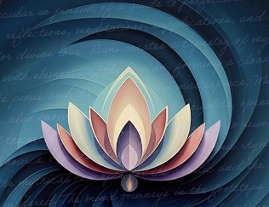
As the Lotus Whirls:
Rumi’s Search for the Meaning of Life
By Zaman Stanizai, Ph.D.
In the name of the Para-Cosmic Consciousness, Whose Oneness of Being pens the verses of perpetually unfolding multiplicities.
From Balkhi to Rumi
Mawlānā Jalaluddin Muhammad Balkhi Rumi is recognized by all these names. Jalaluddin Muhammad is his given name. He is referred to as Balkhi due to his connection with his birthplace, near Balkh, Afghanistan. The name Rumi denotes his residence in the Sultanate of Rûm in Anatolia (Eastern Roman Empire) in Iconium, now known as Konya, Türkiye. Mawlānā, meaning “Our Master,” is an honorific title bestowed upon him by his disciples, and most people commonly address him this way.
In any of his names or titles, his entity is synonymous with poetry, but poetry can signify a thousand different things to a thousand minds. Poets bend and break syntactical and semantic rules in their quest for meaning within the strands of thought expressed as verse. Some converse without versifying on a journey from nowhere to know where. Others rely on the reader to grasp the meaning, gasp, and marvel at the revelation unfurling before them. They hope that an unrestrained expression of thought may blossom into a vibrant display somewhere on the still surface of a pond.
The Whirling Lotus
Rumi’s poetry explores interactive divine love, stirring spiritual emotions deep within the human heart. He skillfully employs the poetic vernacular in pursuit of a guide to perfection. Through his prayers, reflections, meditations, supplications, and lyrical yearnings for divine love, Rumi creates a tapestry of mysticism interwoven with elements of the Qur’an, forming a cloak that envelops the pious and the virtuous. His masterpiece, Mas̄nawī-e Maʿnawī, also known as the Spiritual Couplets, opens with the call of the reed flute, symbolizing a longing to reunite with its eternal source. In the interplay of reason and rhyme, Rumi clarifies the mythical concepts for the ascetic and the aesthetic for the bewildered.
While words can never convey the full depth of thought, poetic parlance occasionally compensates for this inadequacy as it attempts to reveal the jealously guarded meaning behind the veils of seclusion where meaning is woven from metaphors and allegories that go beyond the literal and interpretive. Mawlānā’s poetry defies cultural and linguistic stereotyping despite attempts to reduce the universality of his thought to cultural confines. Rumi’s work has been translated across places and time so that the beauty of thought does not surrender to vernacular dominance, nor is it sacrificed at the altar of poetic niceties.
The mind journeys in the footsteps of the heart and realizes that peace of mind is merely temporary. It strives to attain the tranquility of the soul, aiming to reach a state of contentment with the Divine through subconscious connectedness. There, one hopes for a fleeting glimpse of a spiritual ambiance that soothes the soul in the sublime.
While clarity and ambiguity play their games through a discourse of linguistic simplicity and philosophical complexity, Rumi artfully simplifies challenging thoughts and beautifully infuses complex issues by inviting us into the garden of the Mas̄nawī-e Maʿnawī, where bridges span horizons between the violet mist of daybreak and the magenta dusk of nightfall. In the realm of the imaginal, one may glimpse the beauty of thought flourishing like a lotus on the serene surface of a reflective pond, gazing into the indigo firmament for inspiration while remaining firmly grounded in the nurturing womb of the earth beneath.
As the bluish shade of the lotus petals unfurls around the stamen in contemplation, one can lift layers of unfolding meaning from the lotus and life. Like Rumi, any of us can spin in the cosmic whirl of the sacred lotus with the resonance of the voice within.
Rumi: A Life Lived to the Fullest
Jalaluddin Muhammad lived a life in waves of sequential transitions. The only thing that kept up with him was his shadow. Mawlānā was born on September 30, 1207, near Balkh, Afghanistan. Rumi didn’t have a typical childhood, as his intellectually oriented family put him through a serious educational curriculum early on. The works of great scholars influenced Jalaluddin Muhammad. Under Muhaqqeq Termezi's tutorship, the writings of Hakim Sanā'ī of Ghazni and Fariduddin Attār of Nishapur were, in essence, little Jalaluddin’s first-year primers on Islamic esotericism.
As a migratory bird, Rumi flew through vales and dales from branch to branch, from one valley to the next, and from one country to another. He also did considerable branch-hopping in the conventional sciences of his time. Schooled at the height of Islamic civilization, Rumi had mastered all the traditional sciences by the age of seventeen and aspired to follow in the footsteps of the best of his predecessors and peers.
In general, Rumi was influenced by Muhammad, Abu Hanifa, al-Maturidi, Al-Ghazali, Muhaqqeq Termezi, Baha-ud-din Zakariya, Attār, Sanā'ī, Abu Sa'īd Abulḫayr, Ḫaraqānī, Bayazīd Bistāmī, Shamsuddin Tabrizi, Lal Shahbaz Qalandar, Ibn Arabi, and Sadruddin Qunawi.
Rumi lived in times of great political turmoil and upheaval when the onslaught of the Mongol invasion threatened the whole region. Jalaluddin’s family had to leave their native homeland and migrate west, even though the western parts of the Muslim world had already been devastated by the Crusaders. So, in a sense, Rumi’s family was trying to find a place between two waves of destruction and mayhem. To say that Rumi’s life was eventful is an understatement, and his family barely kept one step ahead of the Mongol hordes.
In those days, traveling was a luxury many could not easily afford. Yet Rumi and his scholarly-minded father, Bahauddin Walad (Baha Walad), were determined to make the best of the worst situation. In the virtual reality of their time, they planned their migration journey from Afghanistan to include great cities and towns in Central and Southwest Asia before they were devastated by the Mongol onslaught. They sought to visit great scholars and men of learning with whom they could discuss matters of significance.
In Nishapur, they met Fariduddin Attār, who was so impressed with young Jalaluddin that he gifted him a copy of a vital tome, the Asrarnamah (Mysteries), and predicted that he would one day become a great man of wisdom.
The child prodigy likely already mirrored the Asrarnamah in his wandering mind as their camel caravan chugged along to Isfahan and Baghdad, where they observed the worldly splendor of Muslim civilization at its height. Then, they went to Medina and Mecca, where they circumambulated the Ka’ba with pilgrims to glorify the Divine. In Damascus, this child prodigy shocked Ibn Arabi with his well-versed spontaneity. As the father and son departed Ibn Arabi’s company, the Shaikh al-Akbar is reported to have commented on the departing guests: it’s as if an ocean is following a pond.
The caravan took these wandering refugees to Malatya, Erzincan, Sivas, Kayseri, and Nigde before settling in Karaman. Jalaluddin was still a teenager when his family finally settled in Konya at the invitation of Sultan Alâeddin Keykûbad, who was lavish with his hospitality. Baha Walad established and taught in a madrassa that Rumi eventually inherited from his father.
Little Jalaluddin benefited greatly from exploring the cultural diversity of the many lands he traversed. Still, more importantly, at that early age, he most likely aspired to become like the great scholars he met in Nishapur, Isfahan, Baghdad, Medina, Mecca, Damascus, and many other cities and towns he visited along the way.
The Mongol invasion left a long trail of death, demise, and destruction behind, burying the sprawl of cultural confluence in Central Asia. The region stood out from the rest of the Muslim world for its civilizational efflorescence in natural sciences, astronomy, mathematics, algorithms, scholarship, theosophy, the arts, poetry, and literary traditions. That entire beautiful reality of Jalaluddin’s childhood simply vanished, and Balkh disappeared altogether.
In the nightmarish tales of ruinous destruction, Jalaluddin realized the transient nature of the world and the temporality of life. Not just as seen in an hourglass, but also as the sands of time make a Buddhist mandala disappear.
Shamsuddin of Tabriz: The Wanderer and Wonderer
Realizing how the world around him changed, Rumi tried to change it even more—through knowledge. At seventeen, he mastered all the conventional sciences and became a sought-after jurist, theologian, and scholar of renowned repute. No sooner had he become the rector of the madrasa, the Islamic seminary his father had left for him, than his world turned upside down once again.
This time, it was the sudden appearance of a dervish, Shams of Tabriz, who held the harness of his horse and led him ‘astray’ to a whole new world—the world of mystical thought, the world beyond human perception, where meaning reigns supreme and where matter doesn’t matter, and the mind doesn’t mind.
After his acquaintance with Shamsuddin of Tabriz, he abandoned all conventional juridical practices to become a mystic.
Shams was a no-nonsense personality who was bursting with ideas about the essence of life and where we all should be headed. The problem was his inability to find someone intelligent enough to understand his thoughts and willing to accept him and embrace his ways, along with all his idiosyncrasies. Rumi grasped the thought quickly and was immersed in the new reality. In this sense, Shams’ depth of thought and Rumi’s ability to understand him with minimal misunderstandings made this pair comparable to other great ones in history, such as Socrates and Plato.
Reality can be defined and perceived through the sensual world, active imagination (beyond the senses), or reason. None of these mediums alone can grasp the totality of perceived reality. Mysticism is a reality beyond these three realms.
When Rumi met Shamsuddin of Tabriz, the former was at the height of his jurisprudential prowess and exoteric knowledge. Shams had come from the providence of a different world—an otherworldly world. Their encounter was so powerful that if they were to walk the same path, there had to be a smashing collision of ideas and perspectives. A paradigmatic shift was not only a certainty but an inevitability. And so, the shift was sudden, polemic, unpredictable, and irreversible.
Given the price and conditions, Rumi was warned of the risks; he was prepared to re-educate and recast himself in the new reality. He could take his trembling first steps into the reality of lofty high ground, where Shams held his hand and then let go of it. Shams led him, pointed him in the right direction, and disappeared. Rumi trembled a bit, but he held on. Shams returned one more time—perhaps to make sure Rumi could walk the talk and talk the walk… and then disappeared forever.
As a serious scholar, Rumi had a dismissive attitude toward poetry, but after Shams disappeared, the man who disapproved of poetry became a poet par excellence—not just to rhyme in reason but to go beyond both.
Rumi left many worlds behind, including religious dogma, theology, law, and jurisprudence. Shams’ weltanschauung didn’t just change his worldview; it changed the world—not just a perspective. Through it, Rumi stepped into a whole other realm.
Rumi entered the new world of ‘alam-e ma’na, the archetypal reality of the metaphysical that can be perceived through the lens of ‘alam al-mithal, ‘the world of likes or similitudes,’ where, according to Avicenna, human potentiality becomes an actuality in the Divine. This is the sphere where, according to Ibn ‘Arabi, existentialization takes place; the sphere into which the high ambition, himma, and prayers of the saints reach to set spiritual energies free and bring potentialities into actual possibilities and higher probabilities. Rumi would later name this realm nakuja-abad, or “nowhereness,” a designation Henry Corbin later ‘mythifies’ and latinizes into mundus imaginalis.
Journey Through the Vales and Dales
In the lore of practical Sufism, as much as in theoretical and philosophical Sufism, there are roadmaps that one must follow step by step. Rumi was undoubtedly familiar with that particular outline in Attār’s Conference of the Birds, where, in all modesty, he writes:
هفت شهر عشق را عطار گشت
ما هنوز اندر خم یک کوچه ایم
"Attar has traversed the seven cities of Love,
We are still at the turn of the first alley."
The seven cities of love, or the seven valleys and stations as they are commonly referred to, are these:
Talab is the first step in a fundamental shift in orientation where one desires union with the Divine Beloved. This is followed by ‘ishq, or love of the Divine, even if manifested in the human domain. Ma’rifat, or intuitive inner knowledge or gnosis, is the third station, followed by estighna, or attaining independence from worldly needs and desires and, in essence, contentment with what little one has. Tawhid/ wahdat, or unification with the Oneness, is the fifth station, followed by hairat, or amazement, awe, or bewilderment. The last station is called fana, or faqr u fana, or the stage of annihilation in the Divine through the impoverishment of the seeker from worldly attachments. At the end of these transformations, a seeker attains an eternity often referred to as baqa-e ba’d fana.
With the proviso that the Qur’an clearly defines ultimate eternity as the sole domain of the Divine, كُلُّ مَنْ عَلَيْهَا فَانٍ O وَيَبْقَىٰ وَجْهُ رَبِّكَ ذُو ٱلْجَلَـٰلِ وَٱلْإِكْرَامِ O “All that lives on earth or in the heavens is bound to pass away: but forever will abide thy Sustainer’s Self, full of majesty and glory, (Qur’an: 55:26-27).” Rumi’s existential philosophy addresses this issue at the spiritual level. For the aware and awakened, life is a journey destined to unite with the one true God. This is achieved by turning toward the Oneness of Being through love. In essence, it responds to an invitation through a longing of the Divine from the very moment of the creation of multiplicity, ارْجِعِي إِلَىٰ رَبِّكِ “Return thou unto thy Sustainer!” (Qur’an: 96-28). This reality is essentiated via an adherence to a tradition of the Prophet saying, «موتوا قبل ان تموتوا» “Die before you die.” Rumi elaborates on this and says:
بمیرید بمیرید در این عشق بمیرید
در این عشق چومردید همه روح پذیرید
Die now, die now, in this Love die;
when you’ve died in this Love, you’ll receive a new life.
Mawlānā is, in essence, paraphrasing the Prophet’s saying, “If you die before you die, then you don’t die when you die.” This is also reflected in Goethe’s most interpreted poem, Selige Sehnsucht, Blessed Longing, where he writes, Stirb und werde, “Die and become – Die to this existence and be reborn on a higher level.” This jibes well with the Buddhist concept of the realm of reality as impermanence, where the emphasis concentrates on the moment’s eternity and demands that one learns how to “Be!” Just be. The somewhat identical Biblical concept can be found in Psalm 46:10, “Be still, and know that I am God,” that is sometimes sequentially shortened to make the point thus:
Be still, and know that I am God
Be still, and know that I am
Be still, and know
Be still
Be
“Be” gains significance in Buddhism’s impermanent reality, yet in Sufism, “Be” is only an initial step in the transformation from “Be” to “Become.” This “becoming,” transforming, changing, and elevating is the central theme of Rumi’s magnum opus, The Mas̄nawī-e Maʿnawī, or The Spiritual Couplets.
There, the mind journeys in the footsteps of the heart and realizes that peace of mind is a mere temporality. It strives to attain the tranquility of the soul, with the ultimate goal of arriving at the state of رَاضِیَةً مَّرْضِیَّةً, “being content and contented,” i.e., “having become.”
Next to the Mahabharata, the Mas̄nawī-e Maʿnawī is one of the longest spiritual poems, with over 25,000 verses contextualizing some 2,500 Qur’anic verses that earn Rumi’s masterpiece the honorary title of the “Qur’an of the Non-Arabs.” Rumi uses the metaphor of the reed flute, where a human archetype is, in essence, a flute on the lips of the Divine. Rumi dives deep into the Divine Ocean and resurfaces with a flute on his lips that becomes the introductory outline, as translated here by Reynold A. Nicholson:
The Song of the Reed
بشنو این نی چون شکایت میکند
از جدایی ها حکایت میکند
Hearken to this Reed forlorn,
Breathing, ever since 'twas torn
From its rushy bed, a strain
Of impassioned love and pain.
"The secret of my song, though near,
None can see, and none can hear.
Oh, for a friend to know the sign
And mingle all his soul with mine!
'Tis the flame of Love that fired me,
'Tis the wine of Love inspired me.
Wouldst, thou learn how lovers bleed,
Hearken, hearken to the Reed!"
The Qur’anic Connections
In the Qur’an, the interactive and proactive Divine dialogues and engages with a humanity that seeks spiritual contentment rather than mere human survival. In the depths of the human heart, there must be a yearning for love, not just an animalistic need for survival. Beyond the metaphors, the raison d'être of our existence must be Love—just Love.
Love must be defined, described, and taught to be lived. Rumi’s poetry demystifies Islamic mysticism so a layperson can grasp the complexity of otherwise deep philosophical thoughts.
This is where the two schools of thought in Islamic mysticism, wahdat-ul wujud, “the Oneness of Being,” that Ibn ‘Arabi primarily adheres to, and wahdat-u shuhud, “the Oneness of Presence,” that Rumi believed in, differ epistemologically. Ibn Arabi is known to tend to elevate matters to the highest level of philosophical complexity so that the panentheist πᾶνἐνΘεός Divine can be exalted and glorified in all things.
In contrast, Rumi steps back to be the observant eye apart from the totality to comprehend the issue. This stepping back, like an artist zooming in and out, is to step into and out of a single perspective where the observer can see both himself and the observer. In this manner, Rumi poetically speaks to the commonality of the layperson on the street without the latter knowing they are destined to meet Destiny.
This difference sparked a dramatic debate when Ibn Arabi’s son-in-law, Sadruddin Qunawi, while attending one of Rumi’s speaking sessions, raised concerns and asked Rumi, “How can you over-simplify such complex issues about the Divine that even philosophers can’t grasp?” To which Rumi is reported to have responded, “Why would you complicate such simple issues that, if properly explained, even a layperson can understand?” (We take liberty with the direct quotations, but the gist of the debate is the same, nonetheless. It must be noted that both Ibn ‘Arabi and Rumi were well-versed in the poetic parlance of their time, Ibn ‘Arabi in Arabic and Rumi in Dari Persian.)
Outlining the Spiritual Couplets
The Mas̄nawī-e Maʿnawī, or the Spiritual Couplets, if understood in their depth, are meant to do just that. The countless allegoric and parenthetical stories, whose many metaphoric layers function as footnotes, sidebars, points of Qur’anic references, and multicultural references on moral lessons and words of wisdom, along with known and unknown anecdotes and fables, were adopted, modified, and revised to serve as the medium for Rumi’s didactic epic, which has widely influenced mystical thought and literature throughout the Muslim world. In this manner, Rumi builds a rainbow bridge and places it right at one’s feet, ending in the high heavens.
The Spiritual Couplets reach beyond the Islamicated world as they weave narratives of cultural diversity from the Sanskrit Panchatantra via Ibn Muqafa’s tales of the two jackals, Kalila and Dimna, where animal characters are developed to teach humans life lessons, as in Aesop’s Fables of 6th-century Greece. In modern times, Coleman Barks takes this one step further by recasting Rumi’s thoughts into a contemporary vernacular that contextualizes the idea in a modern setting. In this way, Rumi’s work not only addresses the common threads of our humanity through cultural diversity in his time, but it does so even more effectively in our times.
Transformations: You are the Story You Tell
In the Spiritual Couplets, Rumi presents the transformation of the self through a multi-layered narrative, similar to Gurdjieff’s model of a carriage, in which the human body is a carriage, human emotions are a horse, the human intellect is the driver, and human consciousness is the willpower, directing the driver as the passenger.
In the same vein, Rumi’s model of spiritual transformation can be encapsulated in the narrative of the king and the handmaiden: A king possessing temporal and spiritual powers purchases a handmaiden as a bride while on a hunting excursion. She soon falls ill, but no physician in the kingdom can cure her, as all suggested remedies have the opposite effect on her as her illness worsens. The king pleads with the Almighty through supplications in the mosque and, in desperation, bathes his prayer rug with tears. Slumber overtakes him in the mosque when a wise old man appears in his dream, giving him the glad tidings that a God-sent physician will visit him to cure the handmaiden.
The next day, a stranger arrives at the palace as a physician who listens to the handmaiden’s story and diagnoses her with a longing for her soul’s desire. He happens to be a goldsmith in Samarqand who must be summoned for her cure. The suggested remedy is that the handmaiden must spend time with her lover to satisfy her heart’s desire. Only after being ‘satiated’ with her worldly desire will she be willing to turn her attention to the king.
When the goldsmith is invited, showered with gifts, and allowed to spend endless hours with the handmaiden, he becomes greedy in fulfilling his desires, falls ill, and dies. The handmaiden distances herself from the worldly and turns to the king in the spiritual realm. The king, who initially desired the handmaiden in ‘form’ but didn’t have her heart, now appreciates receiving the handmaiden’s transformed heart. Worldly, temporal, and carnal love is merely a reflection of divine love, and one should not mistake a mere replica for the real thing.
The metaphoric symbolism in this story, à la Gurdjieff’s model, is that the king in the hunting party is searching for his true self; his purchase of the maiden signifies giving in to the whims and wishes of the nafs ammara, ‘the commanding self,’ or the ego, hungering in greed after ownership. The handmaiden symbolizes desire. The local doctors represent the intellect whose knowledge and abilities fall short of remedying the problem. The king’s retreat in the mosque represents a paradigmatic shift from the worldly to the higher realm, which is only possible if one washes oneself clean of mundane attachments, which the king does by bathing in his tears of remorse and repentance. The God-sent physician is the consciousness.
One will not be liberated if one is enslaved to earthly desires. Such a liberation, no doubt, requires one’s passion for fundamental change. The king realizes that possessing through greed and simple owning can be an illness that worldly remedies cannot cure. Only through the impoverishment of the worldly can one become endowed with spiritual wealth. Only through return and submission to the higher powers can one attain salvation through the God-sent physician, i.e., higher consciousness.
By modeling the narratives with human and animal characters who debate didactic principles, Rumi can instill the principles in a manner that is both educational and entertaining.
Ma’rifat or Gnosis: To Know Oneself is to Know the Divine
Rumi’s meeting with Shams was as much a transformation as a reorientation. Shams’ initial disappearance and subsequent reemergence were another, and Shams’ permanent disappearance was yet another. In the end, Rumi realizes that he must take the altar to alter the world and put his own unique seal on ‘Erfan/Ma’rifat, i.e., Islamic mystical thought.
This transformation made him a man who no longer needed a place in the world; now, the whole world belonged to him. In his time and in the times that followed, in the decades and centuries after, he found his place in the heart of every nation and in the heart of every being who heard a verse or two of his rhymed ideas, a couplet or a quatrain of his versified thoughts, a strand of his ghazal, or an ode of his didactic teachings through which his soul rekindles the love of the Divine Beloved in the heart of every being.
In this realization, Rumi defied giving the Divine any form, shape, or identity except for the conventions that the human mind perceives out of sheer necessity in some manner. While the daring and audacious proclamations of Hussain Ibn Mansur Hallaj and the bold declarations of Shamsuddin of Tabriz may have cost them their lives, Rumi seems to speak the language of love that serves him well in the dissemination of his thoughts, but it also allows him to shield himself behind the metaphors of his poetry when necessary.
Rumi sets afire all perceptive forms of the Divine. He envisions the Ineffable in the imaginal realm, first through the mind and then through the heart. As he fails in both attempts, he accepts It as the Ineffable and draws near to It in supplication. In this poem, reference is made to Hallaj, whose hagiographic ‘legendification’ leads to a perceptive description of the last moments of his life: Each drop of his blood that falls from the gallows to the ground below voices Hallaj’s declaration, ‘I am the Truth’—not as a claim of divinity, but as acceptance of the panentheistic principle that no identifiable entity has the right to claim placeness unto itself unless it is the Divine essence. These blood drops, absorbed by the earth, eventually bloom as tulips, bearing the stigmata in their hearts—a testament to Hallaj’s martyrdom, literally, ‘Witness to the Truth’—brokenhearted in the love of the Divine.
The Ineffable
صورتگر نقاشم هر لحظه بتی سازم
وانگه همه بتها را در پیش تو بگدازم
I am a form giver,
sculpting idols into shapes every moment,
but before you, I melt them all down.
I invoke a hundred phantoms imbued with your spirit,
but when I see your image, I set them all afire.
Are you a jug of wine to quench my thirst?
Or a foe of sober intellect
bringing ruin to every house I build?
My soul pours into yours in a blend,
as I cherish it, absorbing your fragrance.
Every drop of my blood blooms where it falls,
perpetually proclaiming the one truth:
That with you,
I am immersed in the color of love.
This heart of mine is desolate without you
in this dwelling of water and earth,
Enter this house, O soul,
or I, too, shall abandon it in emptiness.
I, too, shall abandon it in emptiness. In solitary silence, our souls embrace limitless space and the stillness of time.